AI has transformed the way sales teams handle conversations. From coaching to summaries, businesses rely on AI tools to improve performance. Finding the best AI tool for sales calls is crucial for consistent growth and customer engagement.
Choosing an AI tool requires comparing features, ease of use, and costs. Sales leaders want solutions that save Time, improve accuracy, and help close deals faster. This Article reviews the top ten AI platforms, outlining the benefits and drawbacks clearly.
Why Businesses Use AI for Sales Calls
AI sales tools automate notes, detect buyer intent, and support coaching. Sales reps spend less Time on admin work while managers gain insights. This translates to increased productivity, enhanced efficiency, and improved win rates for companies of all sizes.
Businesses also use AI to standardize performance, improve onboarding, and ensure compliance. With AI guiding conversations, reps build stronger customer trust. These tools enable leaders to align calls with company revenue goals.
Top 10 AI Tools for Sales Calls
1. Gong – AI Conversation Intelligence Leader
Gong analyzes calls, reveals trends, and improves rep performance. Managers track conversations to find hidden opportunities. Reps receive detailed insights into objections, talk ratios, and conversation quality, enabling them to close deals effectively.
The platform integrates seamlessly with CRM systems, making insights easily accessible. Sales teams choose Gong for strong analytics and coaching power. However, smaller teams may struggle with pricing or the complexity of setup and onboarding.
Pros and Cons of Gong
| Pros | Cons |
|---|---|
| Strong analytics and insights | Pricing can be high for startups |
| Improves win rates quickly | Complex setup for small teams |
| Great CRM integrations | Limited training features |
2. Balto – Real-Time Call Guidance
Balto is designed to coach sales reps during live calls. It listens to conversations and suggests compliance prompts, next actions, and best responses. This guidance helps new and experienced reps maintain consistent call quality across teams.
Companies value Balto for reducing errors and standardizing sales outcomes. It works especially well in call centers and regulated industries. While powerful, Balto is best for scripted calls and may be less effective for open conversations.
Pros and Cons of Balto
| Pros | Cons |
|---|---|
| Real-time call guidance | Pricing may not suit small teams |
| Reduces compliance errors | Works best with scripted calls |
| Easy to use for call centers | Fewer advanced analytics options |
3. Avoma – Smart Notes and Summaries
Avoma helps sales reps capture key details with AI-powered notes. It generates searchable transcripts, action items, and summaries, saving hours of manual effort. This makes it easier to follow up promptly after every sales meeting.
Teams choose Avoma for its affordability and integrations with calendars and CRMs. It simplifies documentation and ensures no details get lost. However, it lacks real-time coaching and can struggle with accent-heavy conversations.
Pros and Cons of Avoma
| Pros | Cons |
|---|---|
| Affordable pricing plans | Limited real-time guidance |
| Excellent call summaries | Fewer compliance-focused features |
| Strong integrations | AI accuracy varies with accents |
4. Salesforce Einstein – CRM-Powered Insights
Einstein brings AI directly into Salesforce CRM, capturing highlights and detecting missed opportunities. It suggests follow-ups, providing sales teams with actionable intelligence without requiring separate software or complex additional systems.
This tool is a great choice for businesses already invested in Salesforce. It enhances productivity and facilitates opportunities for upselling. However, Einstein can be costly, and it only works with Salesforce CRM.
Pros and Cons of Salesforce Einstein
| Pros | Cons |
|---|---|
| Seamless Salesforce integration | Only works with Salesforce CRM |
| Strong call highlights and insights | Add-on pricing can be expensive |
| Helps with upselling opportunities | Learning curve for new users |
5. Second Nature – AI Sales Role-Play Coach
Second Nature simulates sales calls using AI-driven role play. Reps practice with virtual buyers and get feedback tailored to their performance. This accelerates training, shortens onboarding, and boosts rep confidence quickly.
Managers track progress and scale coaching across larger teams without scheduling live sessions. While excellent for training, Second Nature does not focus on live call coaching and may require integrations with learning platforms.
Pros and Cons of Second Nature
| Pros | Cons |
|---|---|
| Excellent for roleplay training | Not ideal for live call coaching |
| Speeds up onboarding significantly | Pricing not always transparent |
| Personalized feedback for reps | May require extra LMS integration |
6. Chorus.ai – Deal Intelligence from Calls
Chorus.ai analyzes sales conversations to reveal deal insights and coaching needs. It identifies buyer intent, sales trends, and missed opportunities that reps can act on quickly. Teams use it for deeper pipeline and coaching visibility.
Managers value Chorus.ai for CRM integration and sales analytics. However, the platform may feel complex for smaller teams and does not provide heavy emphasis on real-time guidance during live calls, unlike other AI solutions available today.
Pros and Cons of Chorus.ai
| Pros | Cons |
|---|---|
| Strong deal insights | Interface can feel complex |
| Excellent CRM integration | Higher pricing for small teams |
| Good analytics for coaching | Limited real-time call guidance |
7. Dialpad AI Sales – Real-Time Transcription
Dialpad AI Sales combines calling, transcription, and coaching into one system. It provides real-time transcription during calls and prompts representatives with keywords and best practices, instantly improving performance and compliance.
Managers adopt Dialpad AI Sales for analytics and scalable deployment across teams. While flexible, advanced features often cost extra, transcription accuracy can vary depending on background noise or challenging call conditions.
Pros and Cons of Dialpad AI Sales
| Pros | Cons |
|---|---|
| Built-in AI transcription | May lack depth vs. specialized AI |
| Unified phone and coaching system | Advanced features cost extra |
| Easy to scale across teams | Accuracy varies in noisy settings |
8. Clari Copilot – Pipeline-Centered Call Tracking
Clari Copilot focuses on linking sales calls directly to pipeline health. It analyzes calls, identifies risk signals, and integrates these insights into forecasts, helping teams align conversations with revenue goals for greater efficiency.
Enterprise teams rely on Clari Copilot to combine call data with deal tracking. While excellent for pipeline management, it is less focused on rep-level training. Smaller teams may find pricing high and setup complex.
Pros and Cons of Clari Copilot
| Pros | Cons |
|---|---|
| Strong pipeline visibility | Less focus on training features |
| Integrates with revenue forecasts | Higher cost for small companies |
| Great for enterprise teams | Learning curve for setup |
9. Wingman by Clari – Live Coaching Tool
Wingman is an AI tool for live call coaching and analysis. It offers prompts during conversations and stores searchable recordings. Sales reps use it for guidance, while managers review performance through detailed reporting.
The platform provides strong analytics and team-wide insights. However, Wingman works best with structured calls and may require upgrades for advanced features. The interface can also feel less intuitive compared to competitors.
Pros and Cons of Wingman
| Pros | Cons |
|---|---|
| Real-time coaching for reps | Advanced features require an upgrade |
| Call the library for managers | Works best with structured calls |
| Good reporting and analytics | UI can feel less intuitive |
10. Fireflies.ai – AI Meeting Notes and Search
Fireflies.ai captures, records, and transcribes sales calls automatically. It creates searchable databases that teams can use to reference past meetings and discussions. Reps use it to track details without manually typing notes during conversations.
This tool is affordable and integrates with many platforms, making adoption simple. However, it offers fewer advanced coaching features than premium solutions, and transcription accuracy may vary for complex terms or technical discussions.
Pros and Cons of Fireflies.ai
| Pros | Cons |
|---|---|
| Affordable and easy to use | Limited advanced coaching features |
| Searchable meeting database | Accuracy varies on complex terms |
| Works with many platforms | Basic compared to premium tools |
Also gr through this amazing coverage: Meta’s Personal SuperIntelligence is Coming | Zuckerburg…
Why You need Best AI Tool for Sales Calls?
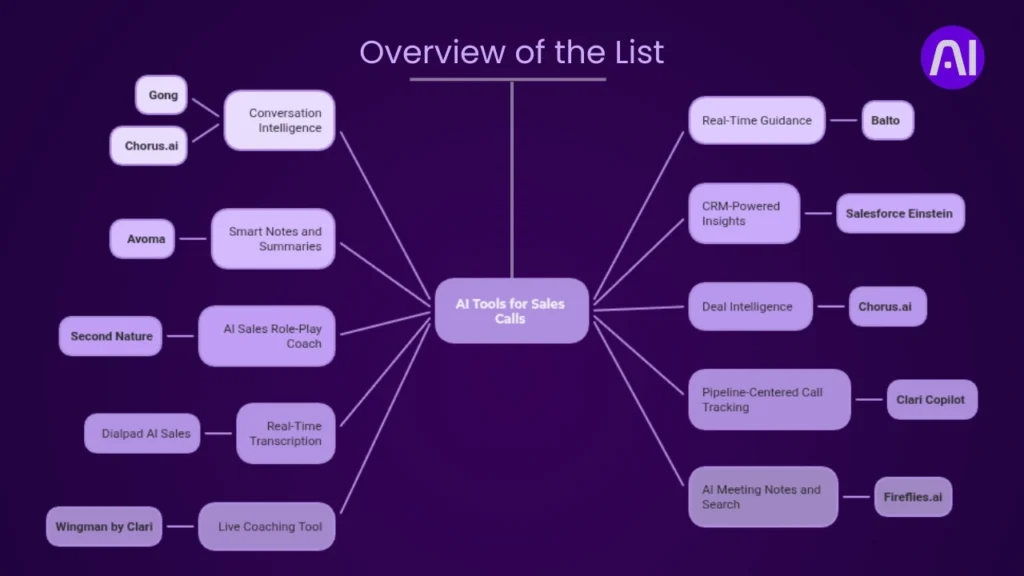
The best AI tool for sales calls helps salespeople perform smarter, not harder. Options include Gong, Balto, Avoma, Salesforce Einstein, Second Nature, Chorus.ai, Dialpad AI Sales, Clari Copilot, Wingman, and Fireflies.ai.
These tools offer features like conversation intelligence, real-time coaching, smart summaries, and CRM insights. By combining AI-driven automation with actionable analytics, they help teams boost efficiency and win more deals with measurable improvements.
Case Study Example: How AI Boosts Sales Calls
A SaaS firm combined Gong for insights and Avoma for note-taking. Gong helped managers detect buyer objections, while Avoma automated action items. Within six months, deal closure rates improved by 20% and efficiency increased by 30%.
This illustrates the value of combining tools based on their strengths. Gong improved deal analysis, while Avoma ensured no meeting detail was lost. Together, these AI solutions created measurable results and boosted overall sales performance.
How to Choose the Best AI Tool for Sales Calls?
Selecting the right AI sales call tool depends on the company’s goals and budgets. Startups may choose Avoma or Fireflies.ai for affordability, while large teams can benefit from Balto’s live coaching or Clari Copilot’s pipeline insights.
CRM-focused businesses may select Salesforce Einstein for seamless integration. Training-focused teams will prefer Second Nature. The key is to align the tool’s features with specific needs, ensuring that adoption brings real improvements.
Conclusion
The best AI tool for sales calls depends on business requirements. Gong delivers analytics, Balto offers real-time coaching, and Avoma simplifies notes. Each platform has strengths that can fit different sales team goals.
Comparing features, integrations, and pros and cons enables leaders to make informed decisions. By adopting the right AI sales call tool, businesses can boost productivity, improve call outcomes, and achieve faster revenue growth.
If you like to discover about productive AI Tools, this guide is for you, AiCut Guide | AI-Powered Video Creation Tool for 2025
FAQ: Common Questions About AI Tools for Sales Calls
Q1: How do AI tools improve sales calls?
AI tools enhance sales calls by analyzing conversations, guiding representatives in real-time, and providing valuable insights after calls. They reduce manual note-taking, highlight buying signals, and help sales teams close deals faster with data-driven recommendations.
Q2: Are AI sales call tools expensive?
Prices vary widely depending on features. Some tools offer affordable plans for small businesses, while enterprise platforms provide more advanced features, including analytics, CRM integrations, and compliance support, at a higher cost. Choosing the right tool depends on team size and goals.
Q3: Can AI tools replace salespeople?
No, AI tools cannot replace human salespeople. They support teams by automating tasks, transcribing calls, and offering guidance. Human skills like empathy, negotiation, and relationship building are still essential for closing deals and building long term client trust.
Q4: Do AI tools for sales calls protect customer data?
Yes, most AI sales call tools follow strict data security standards. They utilize encryption and access controls, and many also enable the redaction of sensitive data. Businesses should confirm compliance with local privacy laws like GDPR or HIPAA before selecting a platform.
Q5: How can I choose the best AI tool for my team?
Start by defining your needs. If you want real-time coaching, choose a live guidance tool. For meeting notes, pick a transcription solution. Consider ease of integration, budget, and security. Testing free trials is the best way to make an informed decision.